
Inside the partnership pioneering women's health research and elevating Erie as a leader in innovation.
Why would a nationally recognized research institute choose Erie?
Because women’s health isn’t a niche; it’s human health.
And Erie isn't a secondary market; it's a catalytic one. It offers something increasingly rare: aligned partners, a diverse and engaged patient population, and a strong philanthropic backbone.
For MWRI, Erie is a place where women's health research is built to thrive.
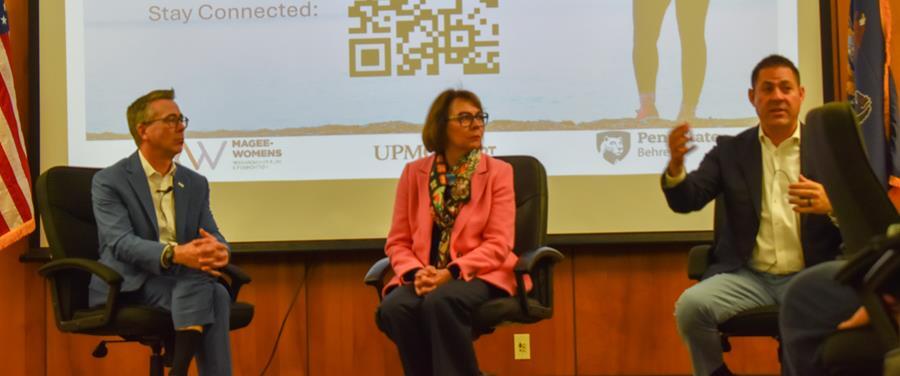
At a recent Jefferson Educational Society Community Conversation featuring Michael Annichine, CEO of Magee-Womens Research Institute (MWRI); Halina Zyczynski, MD, Medical Director for MWRI in Erie; and Ralph Ford, PhD, Chancellor of Penn State Behrend, these leaders explained the stakes, the significance, and the progress unfolding locally.
To understand that progress, it helps to remember the history they’re working against: women were long excluded from medical research. Even after a 1993 course‑correction, funding has lagged. For decades, women’s health garnered only 13¢ of each federal research dollar and accounted for a paltry 2% of national philanthropy. In 2025, federal support fell to just 4.8¢ on the dollar, a disappointing decline.
Erie is helping change that trajectory.
In 2019, when MWRI leaders met with HHF and other community partners, they set a bold, double-barreled bottom line: improve health and economic opportunity in Erie. Achieving that aim meant investing in local research infrastructure to expand access to trials, reflect Erie's diverse and rural populations, and involve clinicians and students in cutting-edge discovery.
Penn State Behrend quickly stepped up. New labs were built, new majors were launched, and a bidirectional research pipeline was created, helping move specimens and ideas between downtown Erie and Knowledge Park. This attracts people back to Erie and draws new researchers in, proving biomedical research can be both a talent magnet and an economic engine.
Better health outcomes for women.
Still, “the goal is not research,” said Annichine. “Research is just one of our tools. The goal is better health outcomes for women.” Because better care for women, he emphasized, has important downstream effects: healthier families and healthier communities.
To that end, MWRI in Erie has brought over 30 clinical trials to the community since 2019, 14 of which are active studies. The team has processed over 22,000 biospecimens and enrolled nearly 1,500 participants locally. MWRI in Erie also awards two $25,000 seed grants annually, giving researchers a stable launching point from which larger grants can be strategically pursued.
As MWRI in Erie continues expanding its research portfolio, the sense in the room at JES was unmistakable: this story is just beginning.
Want to follow along?
Join us at Seeds of Hope on May 14 or watch for more information about the next MWRI Community Conversation at JES, scheduled for August 26.
Don't want to wait? Learn more about MWRI Erie by contacting Courtney Nientimp.